


What is Bizotic Feedback?
Bizotic Feedback is the structured review and improvement system developed by Bizotic, a training and assessment company focused on higher‑education students in India. According to their website, Bizotic partners with more than 85 engineering, management and professional colleges in the state of Karnataka. bizoticedtech.com+1 Their model emphasises continuous assessments, detailed feedback and industry‑aligned training modules. bizoticedtech.com+1
In essence, the feedback system is designed so that after a student takes tests, they receive topic‑wise breakdowns of performance, insights into their strengths and weaknesses, and actionable next steps to improve. This goes beyond simply giving a percentage score; it aims to guide the learner through a cycle of improvement.
Why Feedback Plays a Key Role
Feedback is the bridge between doing and improving. Many students practise tests or training materials, but without good feedback they may not know what exactly to focus on. Bizotic’s approach makes this explicit: you see where you are weak, and you are told how to get better.
When feedback is timely and detailed, students can intervene early rather than repeating the same mistakes. Bizotic claims that continuous assessments allow timely intervention. bizoticedtech.com
Moreover, since Bizotic integrates company‑specific tests (for firms like TCS, Accenture etc) the feedback is aligned with what recruiters expect. This helps students not just learn theory, but shape their preparation toward realistic job‑requirements. bizoticedtech.com+1
How The Feedback Loop Works
Firstly, the process begins with an assessment. Students take tests covering aptitude (quantitative reasoning, verbal, logical), technical proficiency (coding, tools, data structures) and soft‑skills (communication, group discussion, interviews). Bizotic describes their “Assessment Services” as offering benchmarking tests, practice tests, mock tests and company‑specific tests. bizoticedtech.com+1
Once the test is completed, the analytics system gives a topic‑wise breakdown: for example, your score in logical reasoning puzzles, number‑system quant questions, or a specific technical module. This breakdown shows where you performed well and where improvement is required.
Following that comes the feedback report. This is not just a list of scores—it includes guidance on your next steps: topics to revise, extra practice recommended, which modules to attend again. Then the cycle repeats: retest, receive new feedback, monitor progress. This cycle forms the backbone of the Bizotic Feedback model.
| Feature | Description | Benefit to Students | How to Use |
| Topic-wise Assessment | Tests are broken into specific topics like logical reasoning, quantitative aptitude, and technical skills. | Students can identify strengths and weaknesses clearly. | Review each topic’s score and focus study on weaker areas. |
| Company-Specific Patterns | Feedback and tests are aligned with recruiter expectations for companies like TCS, Accenture, Infosys. | Prepares students for real placement scenarios. | Prioritize practice for topics that are most relevant to your target company. |
| Continuous Feedback Loop | After every assessment, detailed reports are provided for review. | Enables ongoing improvement rather than one-time evaluation. | Act on the feedback, revise weak areas, retake tests, and monitor progress. |
| Actionable Guidance | Feedback includes next steps and recommended resources for improvement. | Students get a roadmap for skill enhancement. | Follow suggested steps like additional practice, mentoring sessions, or focused learning. |
| Soft Skills & Communication | Covers group discussions, interviews, and communication skills along with technical aptitude. | Improves overall placement readiness. | Take feedback seriously for non-technical skills, practice consistently. |
| Institutional Insights | Colleges can view cohort performance and identify common weak areas. | Helps improve overall student performance and readiness. | Institutions can provide targeted workshops or mentoring sessions based on feedback. |
| Progress Tracking | Students can see improvements over multiple assessments. | Motivates and shows measurable growth. | Maintain a personal tracker or journal to visualize performance trends. |
Key Benefits for Students
One major benefit is clarity: rather than vague feedback like “you need to improve aptitude”, you get specific: “your logical reasoning puzzles score is 35 % and you made 8 mistakes on data‑interpretation”. That makes improvement plans easier.
Next is efficient learning: by focusing time and effort on weaker topics rather than uniformly studying all topics, students save time and make faster progress.
Then comes job‑readiness: because the tests and feedback are aligned with industry hiring patterns (company‑specific training modules included) students gain a realistic preparation. Bizotic lists preparation for companies such as Accenture, TCS, Infosys, Capgemini. bizoticedtech.com
Another benefit is motivation: when feedback shows measurable improvement (for example, logical reasoning score moves from 25% → 50%), students feel progress, which encourages further effort.
Finally, institutions (colleges) benefit too: the feedback mechanism allows them to observe cohort performance, identify weak modules across batches and intervene at an institutional level. Bizotic emphasises building partnerships with colleges via this mechanism. bizoticedtech.com
Real‑World Student Experience
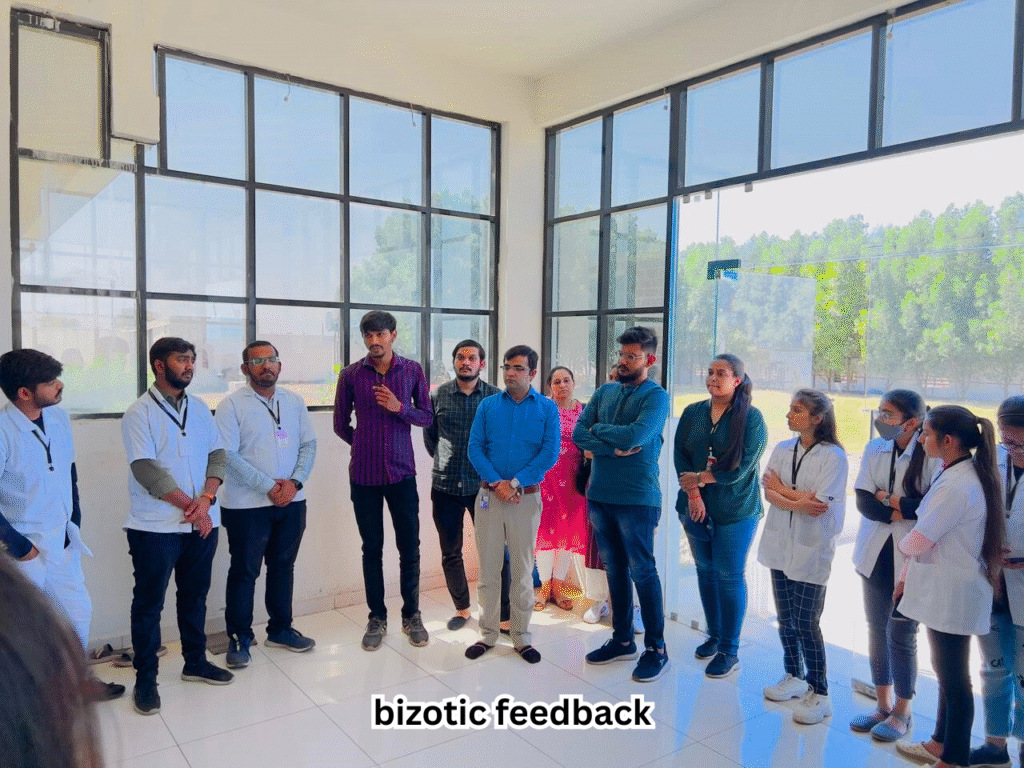
According to a review on the website MakeAllure, students appreciate the “detailed feedback system integrated into assessment services” at Bizotic Training. Makeallure The testimonials emphasise how topic‑wise breakdowns and interactive sessions helped them understand their skills gaps and move forward.
Moreover, employee reviews of Bizotic (via AmbitionBox) show an average rating of 3.9/5 based on 5 reviews. While these are internal employee reviews rather than student feedback, they indicate an environment of moderate satisfaction in terms of skill‑development and job security. AmbitionBox
These show that while the system is well‑received in several cases, it’s not perfect for every learner—context and follow‑through matter.
Why Bizotic’s Feedback Approach Stands Out
What differentiates Bizotic’s framework is the integration of three strong pillars: continuous assessments, detailed analytics/feedback, and industry‑relevant preparation (company‑specific tests). Their website lists these as “Continuous Assessments”, “Engaging Training Sessions”, and “Detailed Feedback System”. bizoticedtech.com
Many training companies give you tests or mock interviews, but few attach the loop of structured topic‑wise analytics plus actionable next steps. Bizotic places the feedback mechanism at the heart of their offering.
Furthermore, their training covers a broad spectrum: soft skills, aptitude, technical proficiency and placement readiness. This breadth means the feedback isn’t just on one narrow skill but a range of competencies. bizoticedtech.com+1
Lastly, by partnering with multiple colleges and aligning to actual recruiter patterns, the system is geared to produce results that are relevant for jobs, not just academic performance.
How Students Can Use Bizotic Feedback Effectively
After each test, the student should proactively review the feedback: look at the topic‑wise breakdown, identify the weakest topics. For example: “I scored 30% in logical reasoning puzzles, 60% in quantitative number systems, 75% in verbal ability”.
Next, set a personal action plan: allocate more study time to those weaker topics, use resources such as extra practice sets, attend drop‑in sessions, ask mentors targeted questions.
Then track progress: retake mock tests after a focused practice cycle and compare results. If you see a steady upward trend, that’s a sign the feedback loop is working.
Discuss with your trainer: if your feedback shows you consistently struggle with a topic (say, data structures coding), seek additional guidance—maybe a one‑on‑one, revised resource, or peer study group.
Maintain the cycle: test → feedback → practice → retest. Make the feedback report your map of where to go next, not just a document you glance at.
Also include non‑technical topics: soft‑skills, communication, group discussion are often quieter, but feedback might uncover weak areas there too—don’t ignore them.
Finally, reflect monthly: “Where was I last month? Where am I today? What feedback changed? What still needs work?” This reflection helps keep motivation alive.
Final Thoughts
The Bizotic Feedback system offers students a structured, actionable path from skill‑gap to skill‑improvement. With detailed analytics, topic‑wise insights, and job‑aligned training, it turns learning into measurable progress instead of guessing games. For students preparing for placements, this kind of feedback mechanism shifts the focus from “I hope I’m ready” to “I know I’m ready”.
Of course, the tool alone is not enough—the student’s engagement, effort, and consistency are vital. Feedback is only powerful when you act on it. But if you adopt a feedback‑driven mindset, use the breakdowns wisely, and stay disciplined in your follow‑through, you will likely see meaningful improvements.
If you’re choosing a training provider or considering a feedback‑based preparation system, look for the kind of cycle Bizotic offers: assessments → analytics → next‑steps → reassessments. That loop is what makes the difference between “taking many tests” and “getting better each test”.
In short: know where you are, know where you need to go, and use feedback to map that journey. With Bizotic’s model, that journey is laid out clearly — it remains up to the student to walk it.
FAQs
Q: What is Bizotic Feedback?
A: Bizotic Feedback is a system that provides students with detailed, topic-wise performance reports and actionable guidance to improve skills.
Q: How does Bizotic Feedback help students?
A: It identifies strengths and weaknesses, suggests next steps, and helps learners focus on areas that need improvement efficiently.
Q: Are Bizotic Feedback reports company-specific?
A: Yes, the feedback aligns with real recruiter patterns for companies like TCS, Accenture, and Infosys to prepare students for placement tests.
Q: Is Bizotic Feedback useful for soft skills?
A: Absolutely. The system covers communication, group discussions, and interview readiness alongside technical and aptitude skills.
Q: How often do students receive feedback?
A: Feedback is provided after each assessment, creating a continuous improvement cycle of test → feedback → practice → reassessment.